

Creating the customer satisfaction programme at SBS
For the past 5 years SBS had been measuring customer loyalty, but with no department dedicated to driving it forward. This meant SBS was underperforming, and it needed to change.
That responsibility was given to me, when I was hired as the single team member of the brand new Customer Satisfaction programme.
This case study tells you how I tackled this huge task to get SBS to a place today where we can gladly say our customers are much happier than they were last year, and hopefully for the foreseeable future.
+7→+38.2
Annual NPS, 2024 to 2025
3,500
employees globally across 50 offices
25
workshops facilitated
4.85/5
average feedback score
My Role
Customer Satisfaction Intern at SBS from March 2025 to June 2026.
What I did
User research, UX Design, communication planning (internal), user persona + customer journey map creation, learning design, workshop facilitation, data analysis (quantitative + qualitative), stakeholder negotiation, branding, creating promotional materials using Canva Pro, Figma and Adobe Photoshop, Illustrator, After Effects, Premiere Pro.
Constraints
This was a brand new programme so nothing had been done before I joined. I had no other team members beside my manager. There was a substantial language barrier (many employees don’t speak fluent English), budget limited, time pressure from higher ups.
Confidentiality
Unfortunately I can’t show everything I’ve done due to confidentiality and privacy reasons. Anything shown has been approved.
01
The problem
on the surface
SBS didn’t have an internal team dedicated to understanding customer needs
I was hired because I know how to prioritise customer needs and in turn find customer-centric solutions, which in a nutshell is what SBS desperately needed.
My manager’s pitch on the first day was the following; For the past three years, all SBS had to measure customer satisfaction was the NPS (Net Promoter Score), which measures customer loyalty. SBS's score had been below what they anticipated every year since records began in 2022, and that needed to change.
So, it seemed he just wanted to boost the NPS. But, to boost the NPS is certainly not as simple as it seems, and also just caring about the number rising isn’t enough to make it rise. I needed to know what drove the NPS.
To conclude, a poor NPS and no one championing customer satisfaction at SBS were the problems on the surface, but were they the problems below it?
02
The research
Starting with open conversations to understand the real problems
I took a Eurostar to the SBS HQ in Paris, as this was where I could have open conversations with teams easily, understand their current problems, and where they feel attention needs to be made, This would allow me to dive deeper into what the real problems are, not just what they appear to be.
Teams I spoke to across the customer journey to create the service blueprint
The teams in purple have the direct contact with customers, whereas the green teams have no contact.
My method for gathering and analysing feedback from interviews
This was the method I used for understanding the feedback I received, as without this the results would probably become biased and not reflect the actual views of those I interviewed.
Organising the findings into a pattern matrix
Once I had completed interviews with those involved across the customer journey, I organised their feedback into clusters and identified what team said what. This gave me a clear view of where the main problems were.
Creating an affinity map
The pattern matrix helped when creating the affinity map, as it showed me what themes were the most relevant against the data I had.
Five findings
After conducting the thematic analysis, these were the 5 main themes which I found. My questions were directly related to customer satisfaction and the majority of feedback related to one of these main themes outlined below.
It was clear that there was a lack of customer-centric knowledge and this wasn’t the teams fault. It was the lack of infrastructure related to making sure that everyone at SBS is taught customer-centric principles to ensure they are meeting customer needs.
This was what I needed to figure out next.
I posed the question:
How might we make an entire workforce of 3,500 people around the globe customer-centric?
03
The strategy
03
the strategy
Well… You Listen, you Understand, and you Act.
But how did I get to this conclusion? Well, the how might we question was far too big to answer on its own so I broke it down into a smaller How Might We for each of my five main themes and came up with ideas for each one, and then grouped the ideas that belonged together, which gave me the three stages of Listen, Understand and Act.
This is detailed in the graphic down below.
The poster
I created this poster using Figma which was put up in every SBS office around the globe, this made the strategy visible pretty much all the time.
04
The plan
Creating a communication plan to bring the strategy to life
The graphic below gives an overview of the plan, as the full document can't be shared for confidentiality reasons.
It shows 16 topics, grouped under Listen, Understand and Act and launched in phases, with each one continuing once it starts.
The topics came from three places:
The problems colleagues had raised in my research
Initiatives that already existed at SBS but weren't being communicated,
Gaps I noticed along the way, such as how AI and employees' own experience at work affected customers.
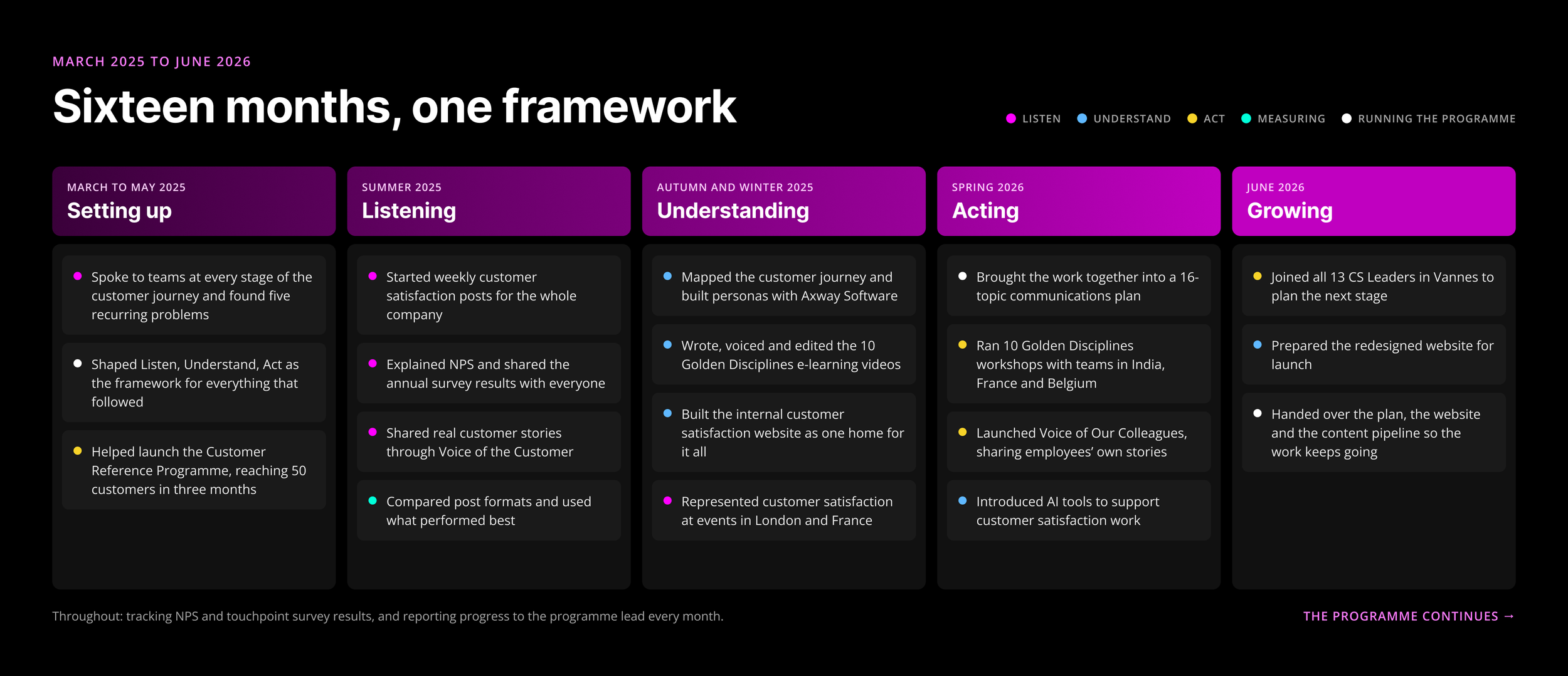
The graphic above shows in more detail how I actioned the framework from when I began in March to when I handed over the plan at the end of June 2026. The timeline shows how the programme built up over time, with each stage laying the groundwork for the next.
05
Education
Using listening and understanding to create empathy
Telling 3,500 people to be more customer-centric achieves very little on its own, because knowing a principle exists and actually changing how you work are two different things.
10 Golden Disciplines
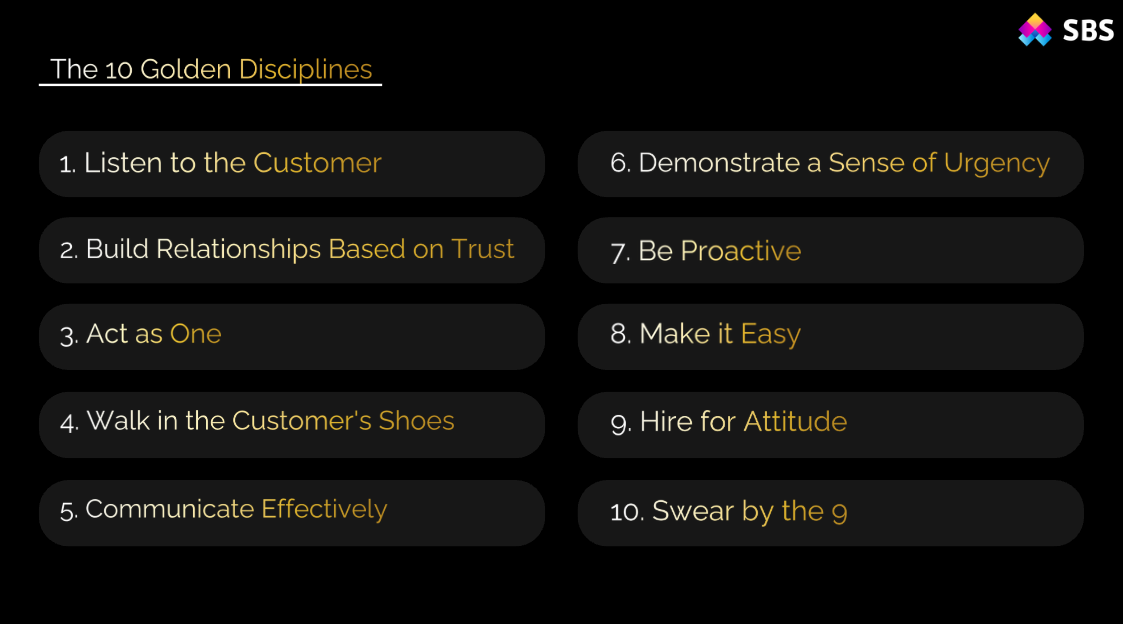
The natural first task was to teach customer centricity in a simple, easy to understand way. The 10 Golden Disciplines achieved this goal, as they laid out 10 customer centric principles which boosted the customer experience according to research conducted at Axway Software.
Personally, I would have liked there to have been more ideation and research done at this stage, as I think we could have thought of a more novel and interesting way to teach customer centricity. I think that getting feedback on how people like to learn, and then developing a strategy would have been a better approach. However, again, time was a huge constraint which stopped this happening unfortunately.
Poster
I created this poster using Figma to boost visibility of the campaign which was printed and put up in every SBS office around the world. The poster was validated by the Design team before it went into printing production.
Training modules
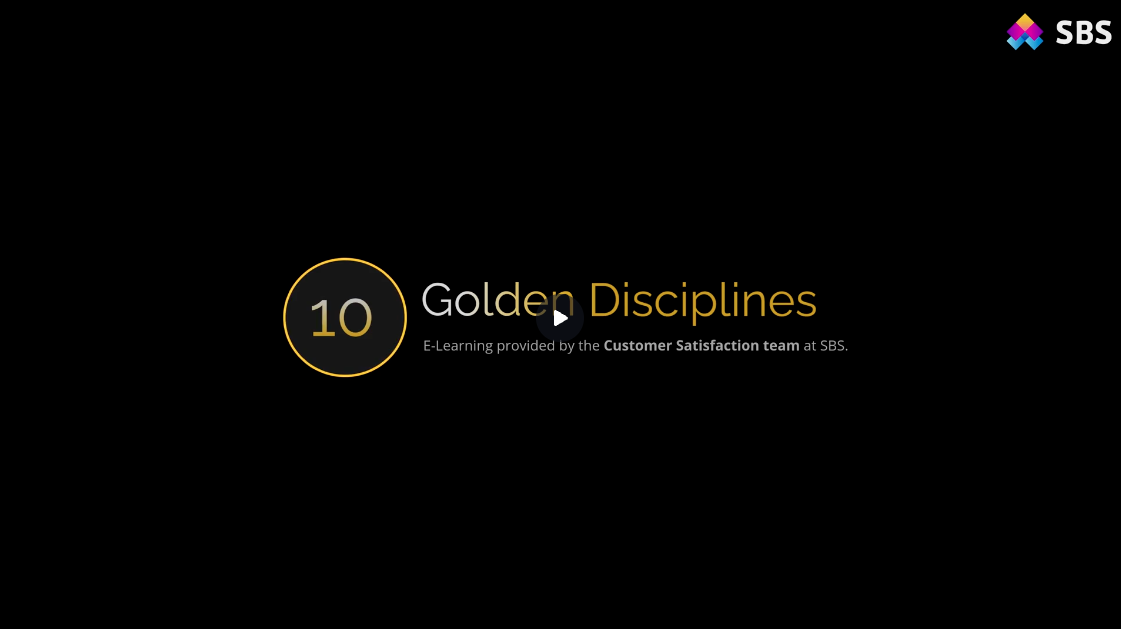
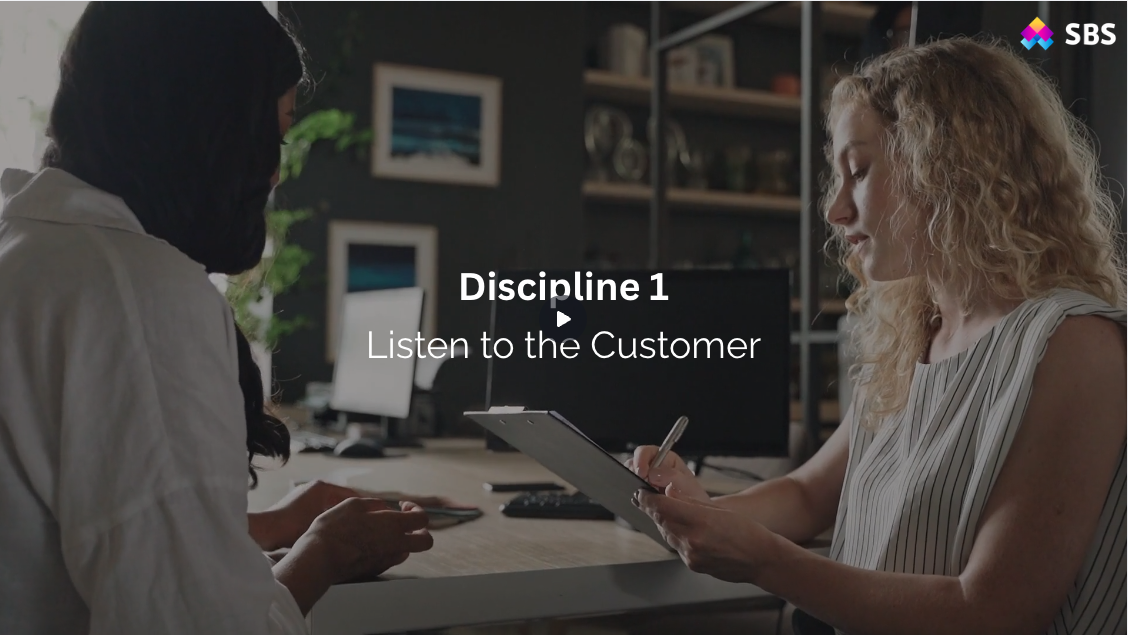
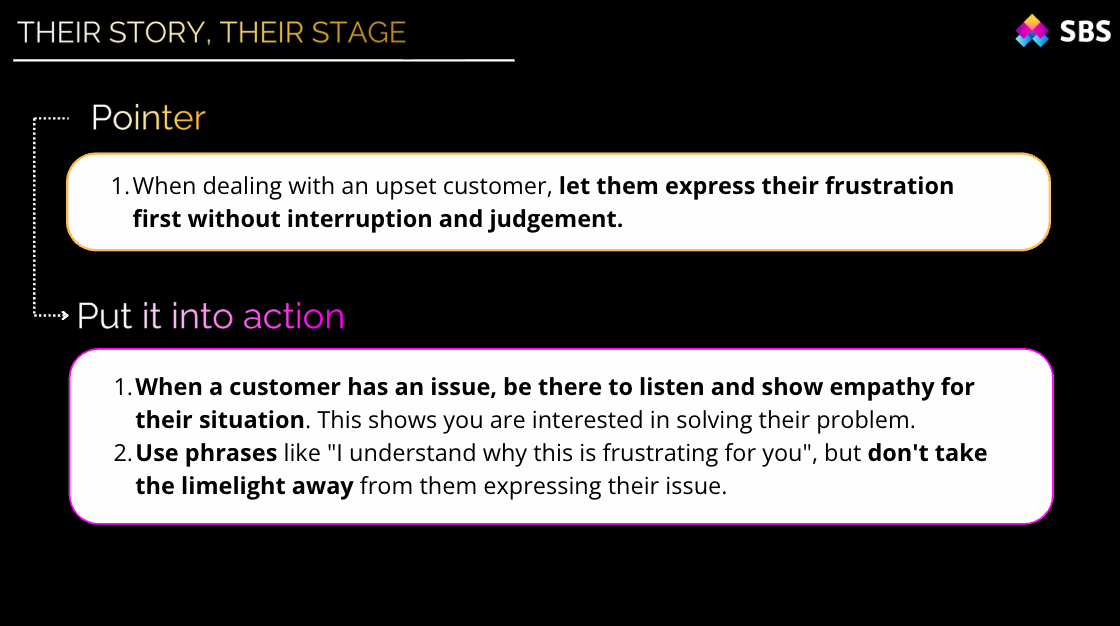
It was decided that the easiest way to teach the disciplines to 3,500 people was through an e-learning training course. Therefore, I was tasked with producing a set of 10 videos which were mandatory for everyone at SBS to complete.
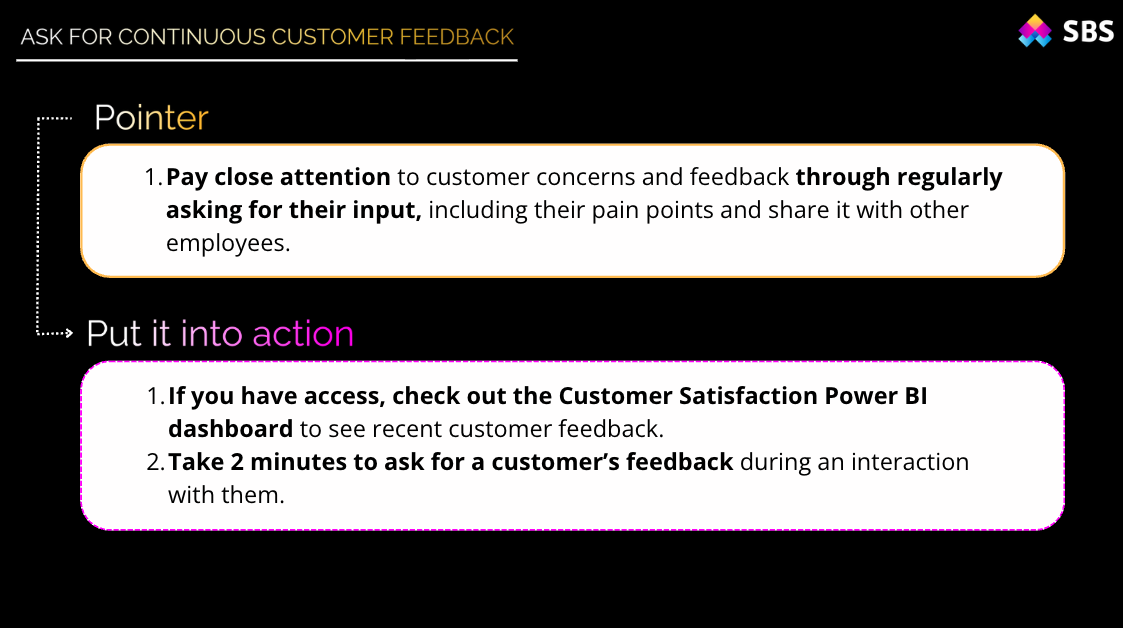
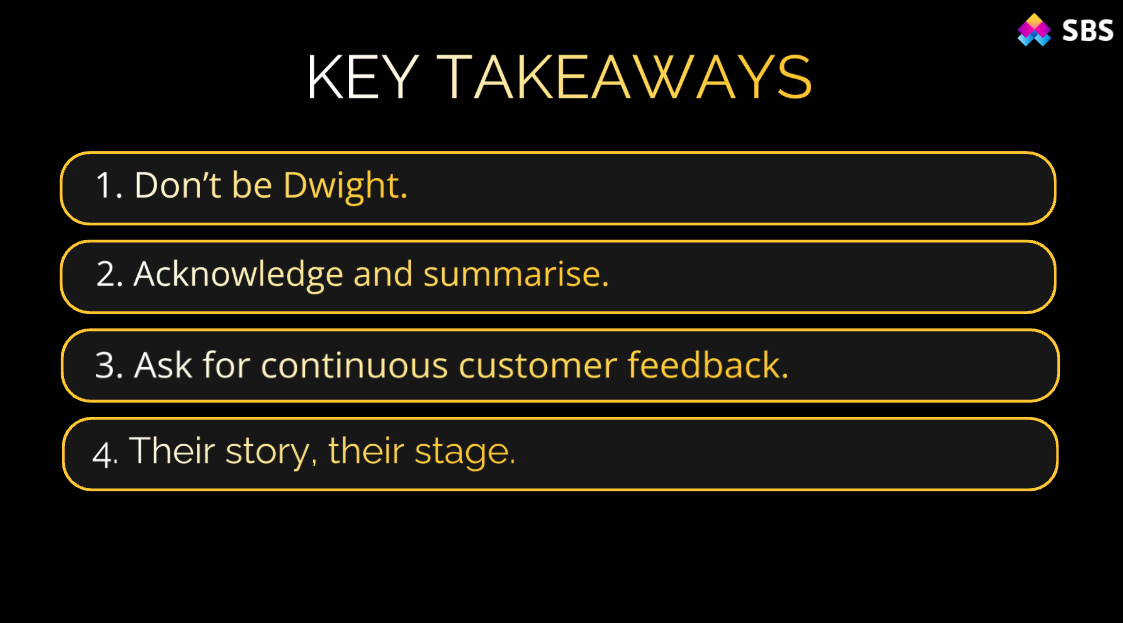
I looked into learning design and followed the best principles to make the process as engaging and enjoyable as possible. I included elements of humour, recorded the voiceover with my own voice, kept each video to 5 minutes or less and made the takeaways for each video easy to understand using simple language.
We conducted a pilot phase for this, and used the feedback to adjust the videos if needed.
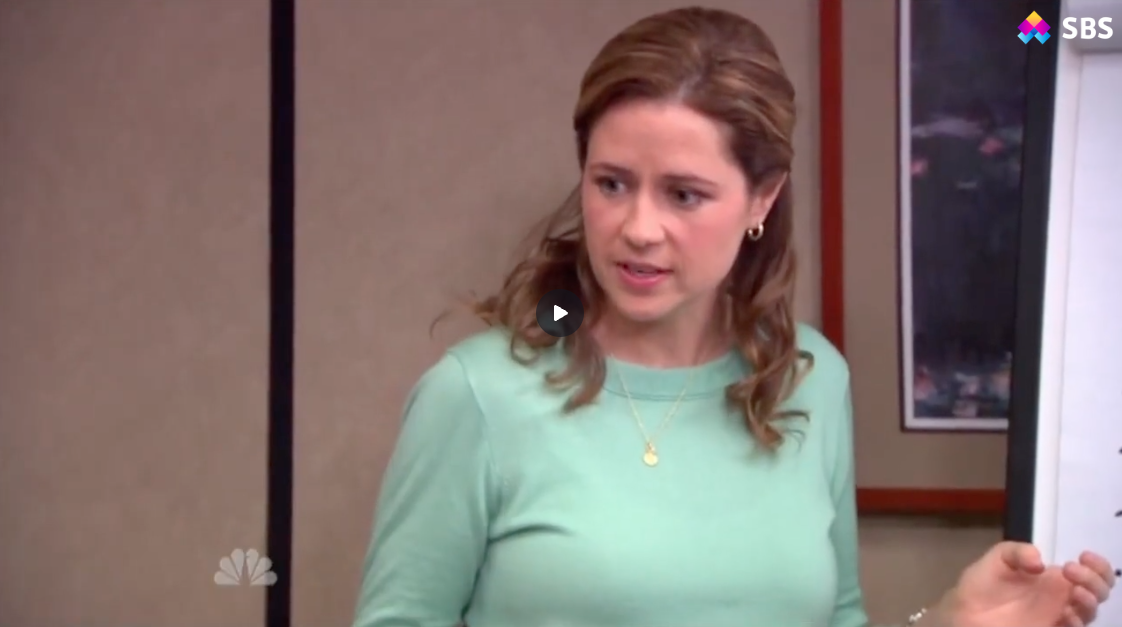
Below is an example of one of the videos I made, each video followed the same structure.
300+ workshops
E-learning gives people discipline, but watching a video on your own doesn't change how you work, so the next step was getting teams to work together.
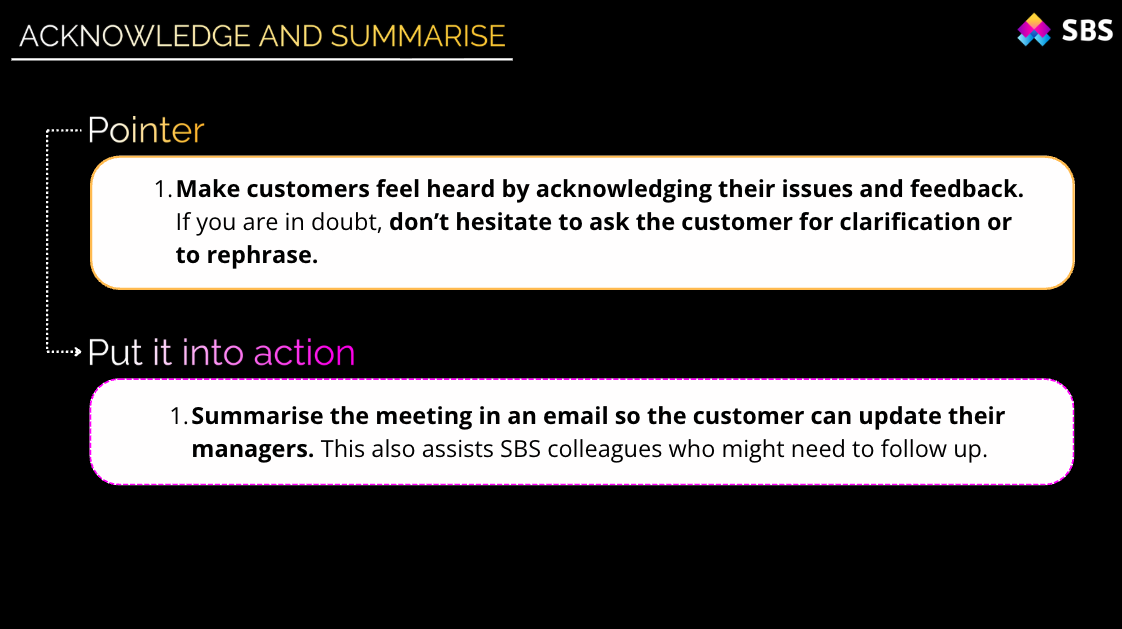
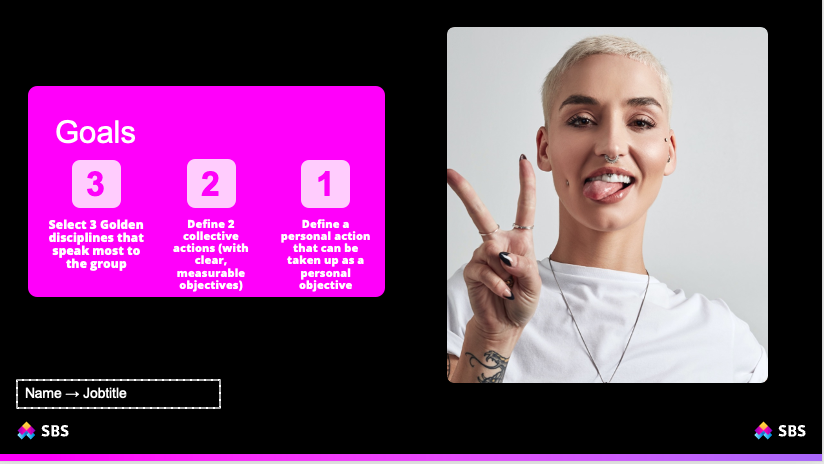
I facilitated over 25, 2 hour workshops with teams of 10 to 15 people from around the world. These were great for people to share ideas amongst each other about how to boost customer centricity collectively and individually as they created SMART Actions together.
A pilot phase was carried out for this stage too, however, the feedback was not taken into account before the first phase began due to time constraints. However, I adjusted my facilitation approach in response to the feedback where I could.
For example, I removed infantilising features of the workshop, shortened the time spent explaining and increased the group activity. This received a positive response.
E-learning and workshop feedback
After both the e-learning and workshops, attendees were required to complete a Microsoft feedback form, which I then analysed and shared in a weekly meeting. The graphic below shows that the e-learning scored highly (4.85/5), and the workshops performed well (4.43/5) - I tried to make changes where I could but as stated earlier the appropriate changes were not made due to time pressures.
Video testimonials
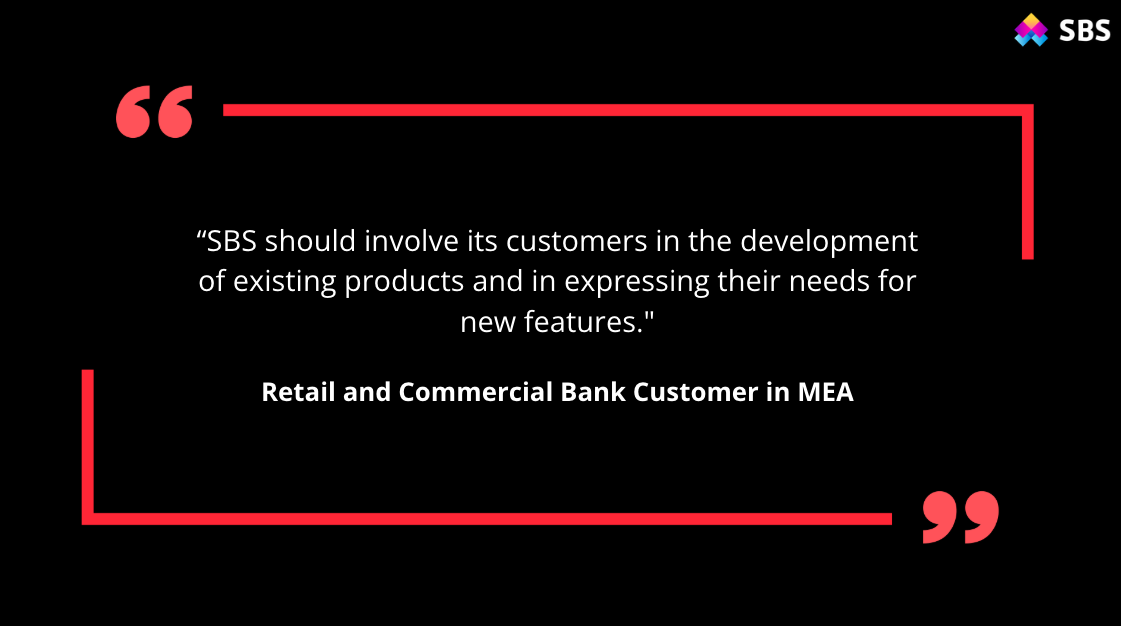
I messaged those who had participated in both parts and asked if they would like to give feedback in a video to be shared internally. Below are some examples of what people said.
“The 10 Golden Disciplines are not just rules, it’s a mindset, we are motivated to make customer satisfaction not just a goal but a habit”.

Khalil Zineb
Operational Manager for Amplitude
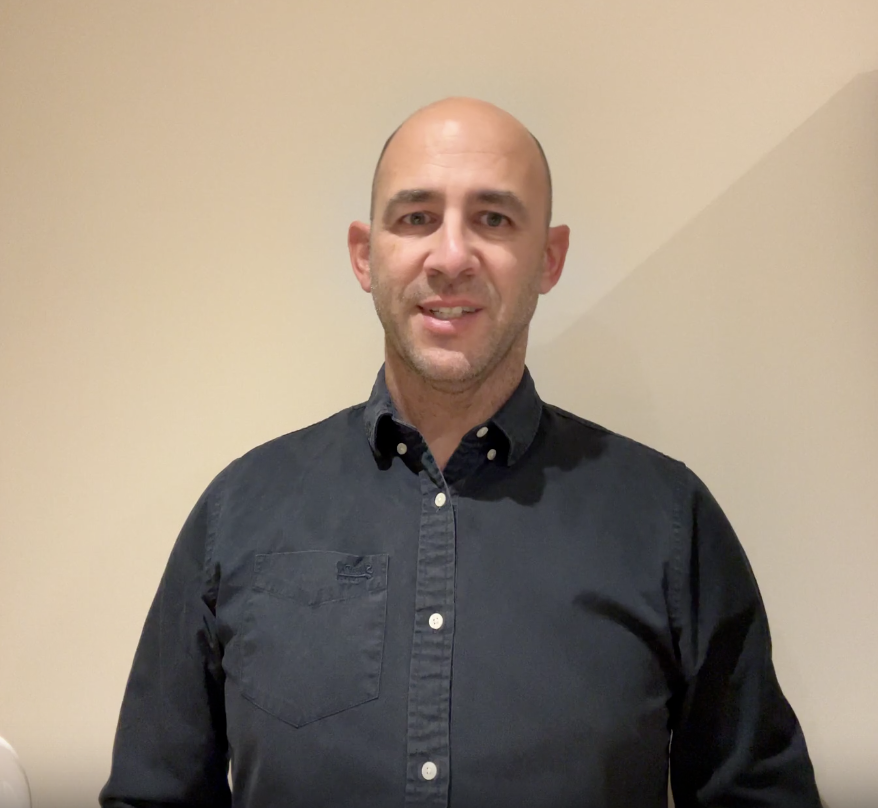
“It’s been a powerful approach that has helped us stepback and improve how we work to deliver an even better service to our customers.”
Cedric Froger
Head of Customer Support
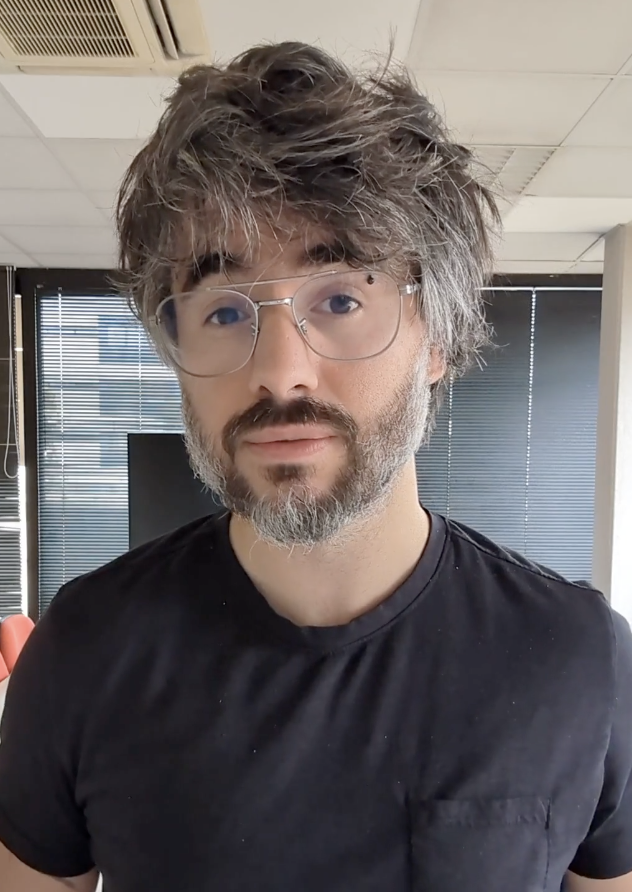
“As part of SBS Support, customer satisfaction is one of our main concerns which is why we truly believe in the initiative.”
Jonathan Salmon
SBS Support
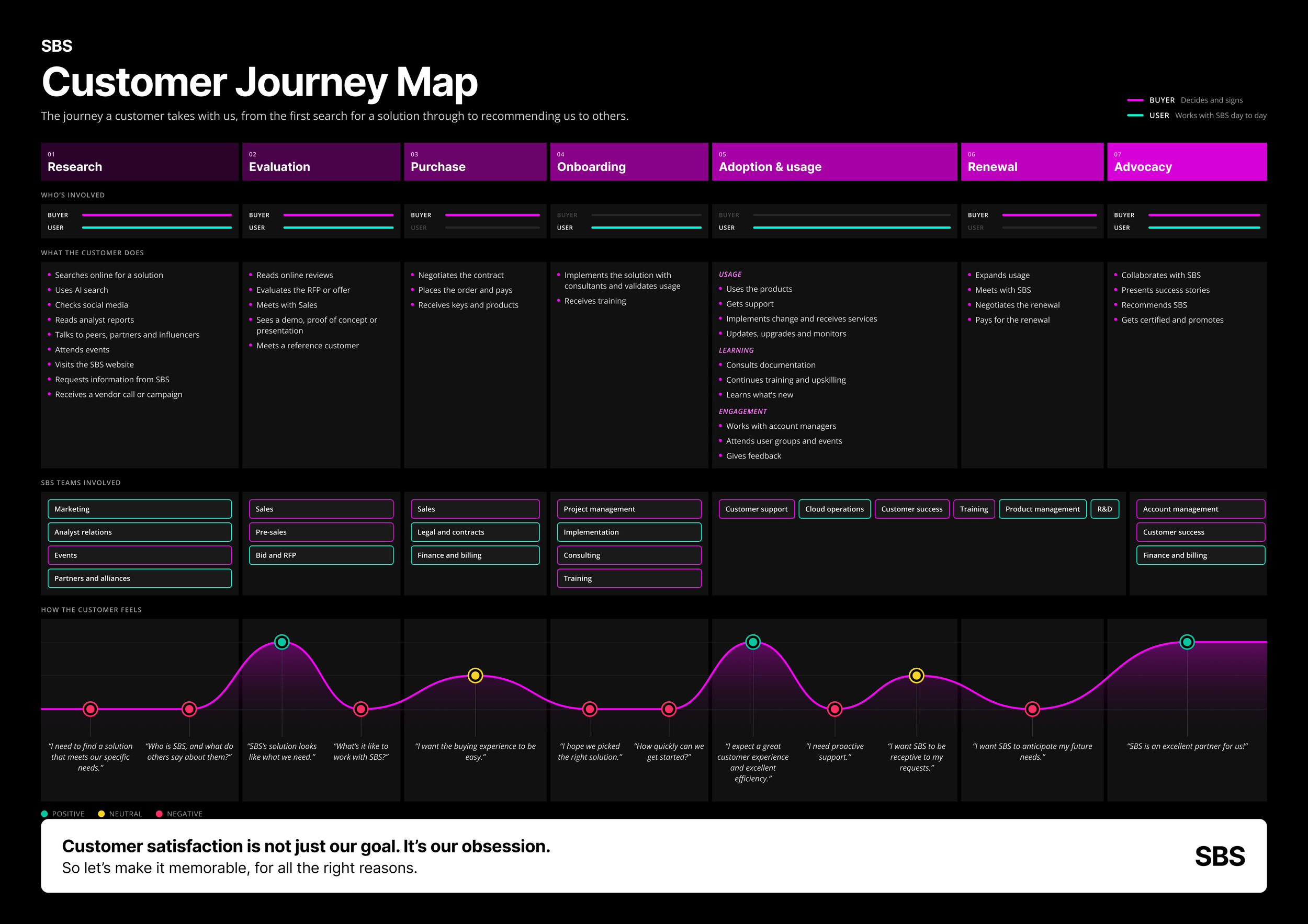
Customer Journey Map
The Customer Journey Map was created before I joined SBS by using information given to us by our sister company Axway Software. However, I noticed that this map didn’t truly reflect SBS customers based on my analysis of NPS feedback. Therefore, I added AI Search, Visit SBS website, and Social Media. I also changed the emotions to better reflect those of our customers.
The final map is shown below.
Poster
Just like the 10GD poster, I created a poster using Figma which was put in offices to improve visibility and awareness of the map. I also created a promotional video which was shown on TV screens. These two promotional materials were approved by the Design team.
Personas
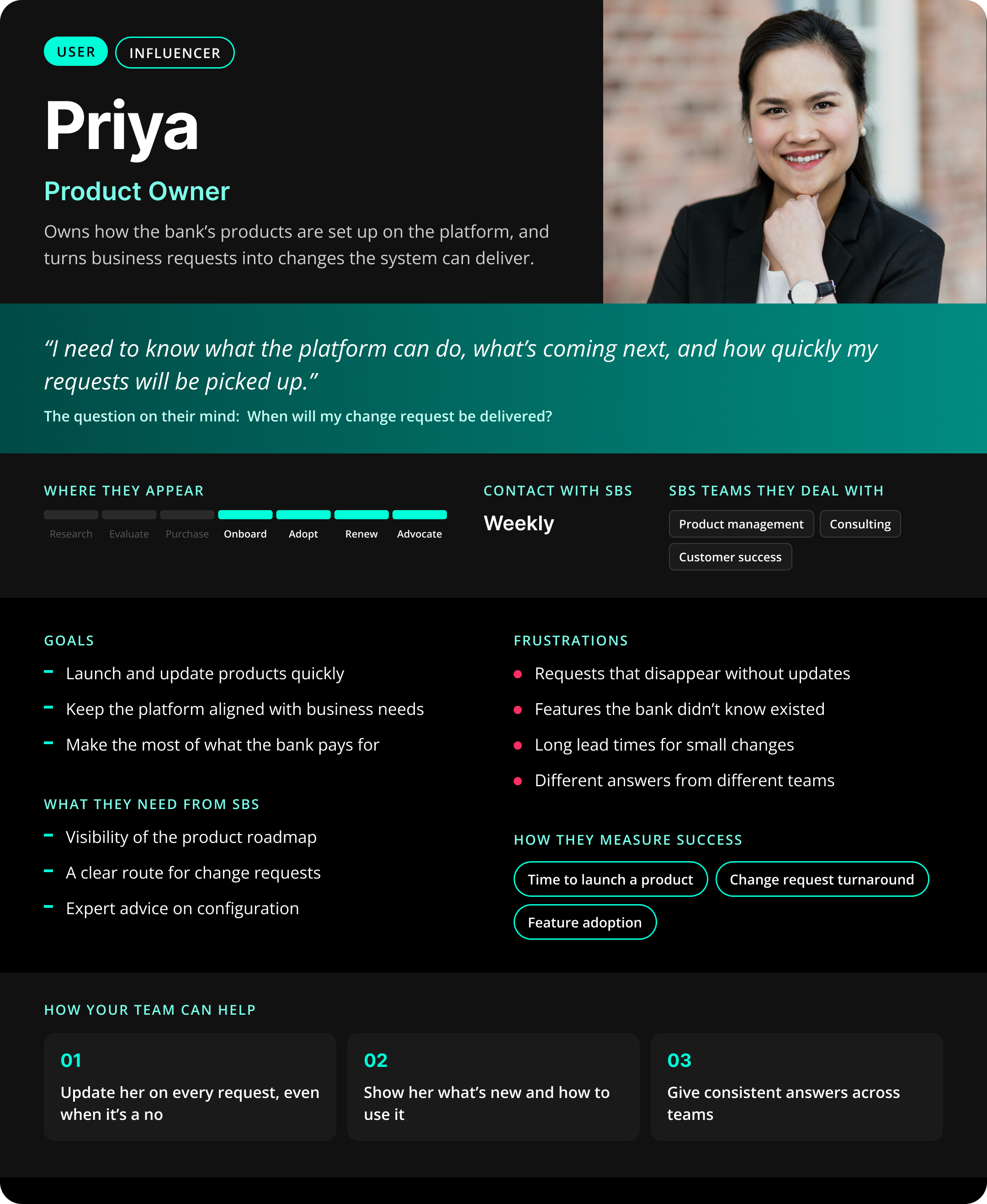
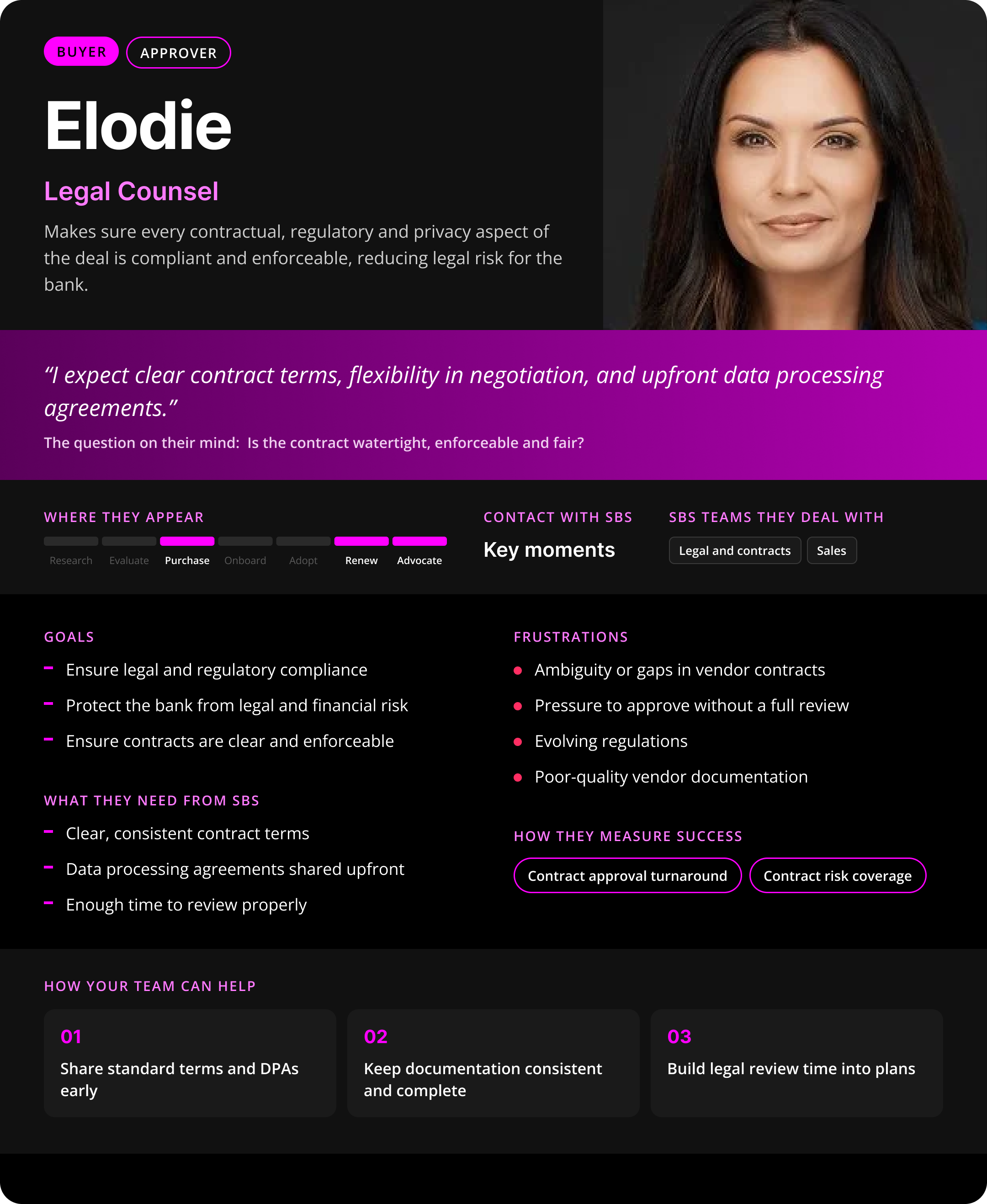
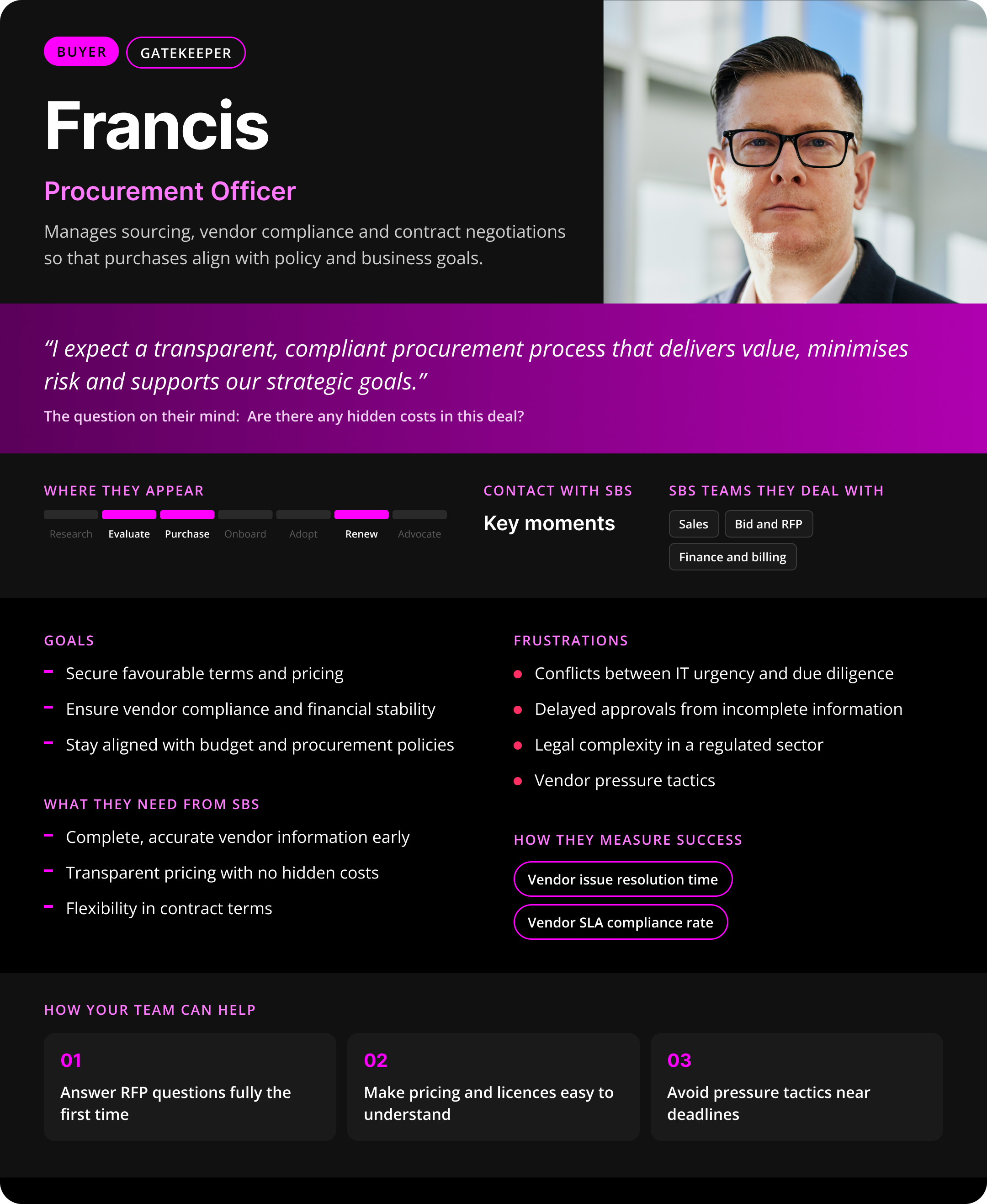
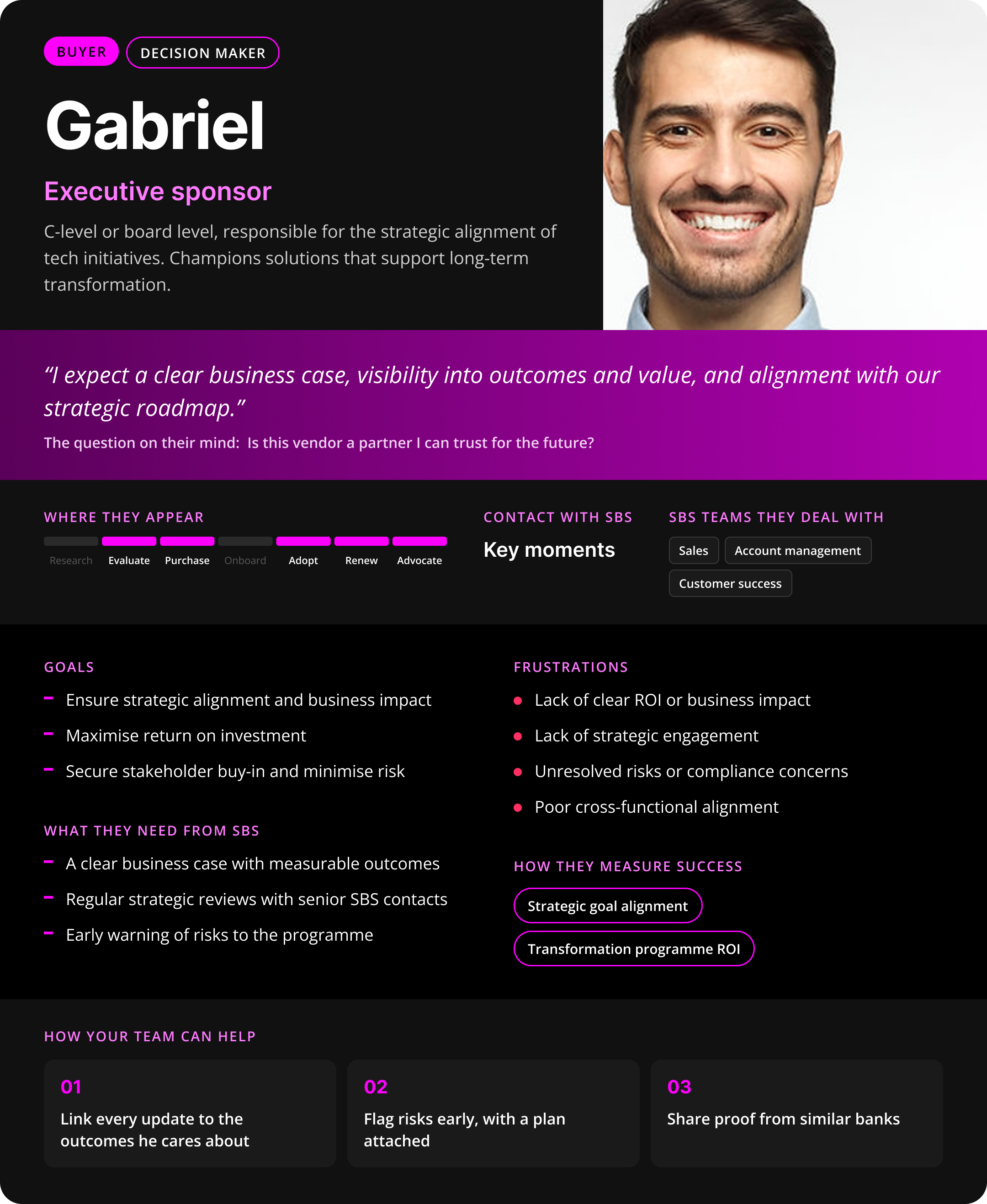
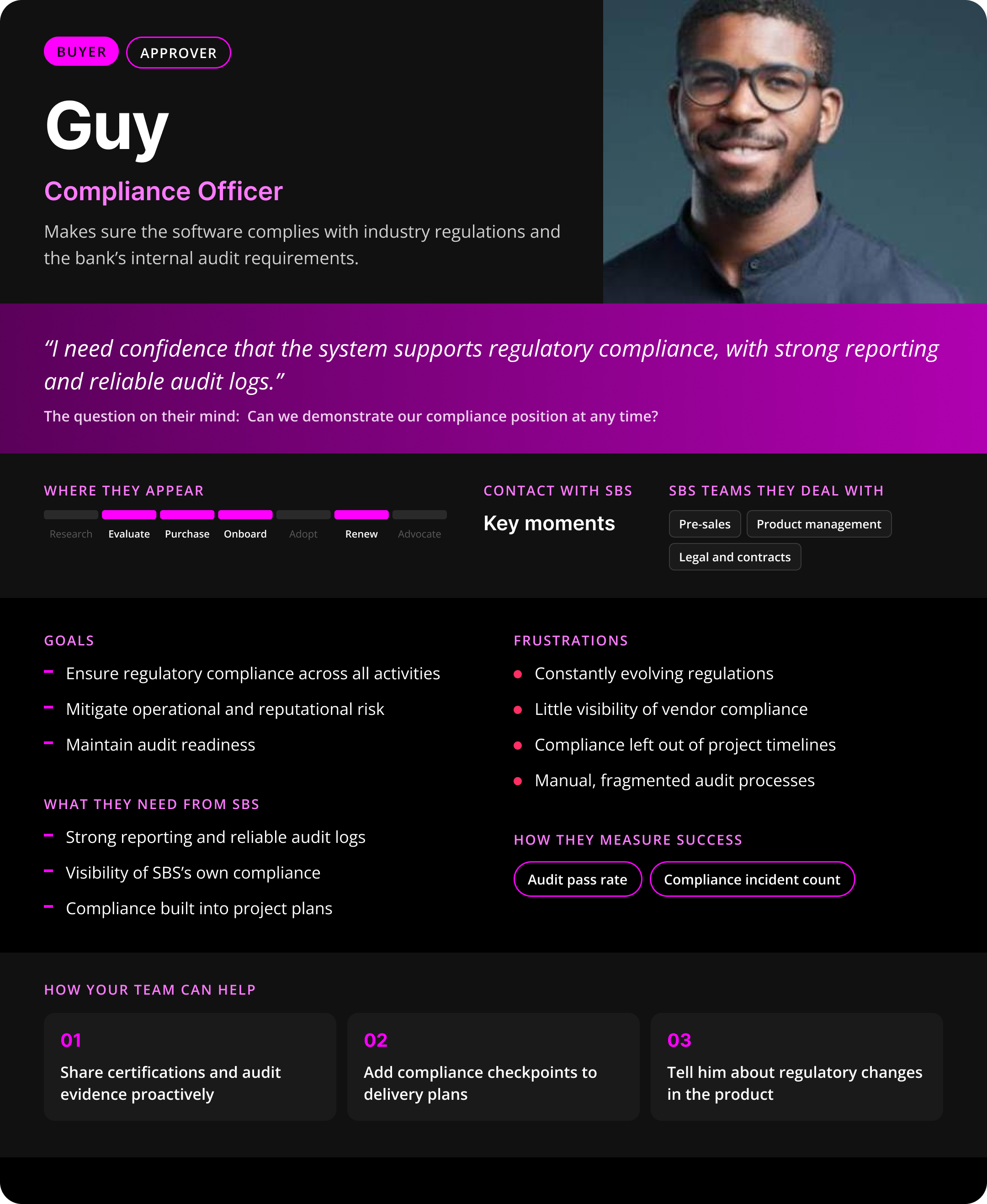
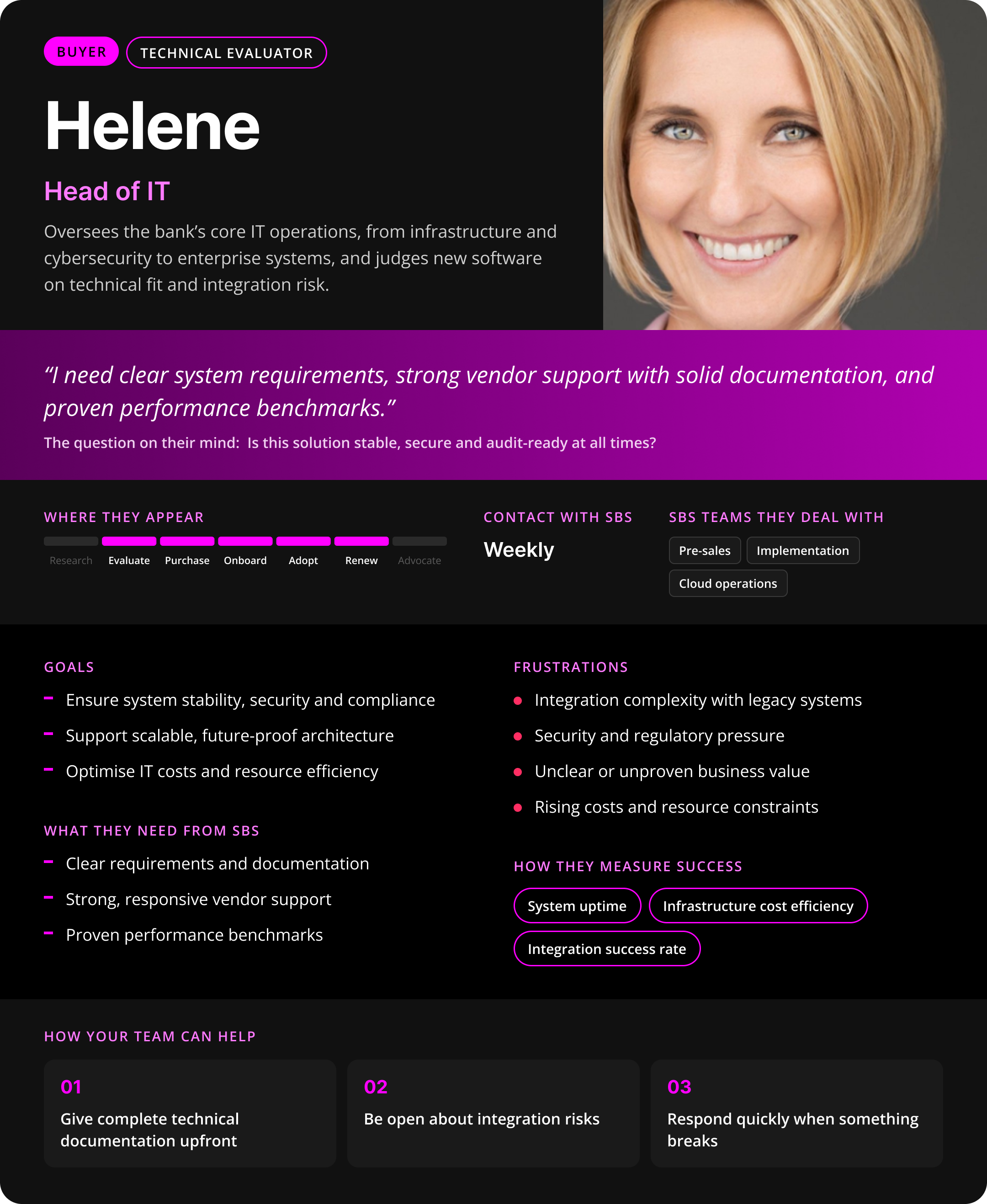
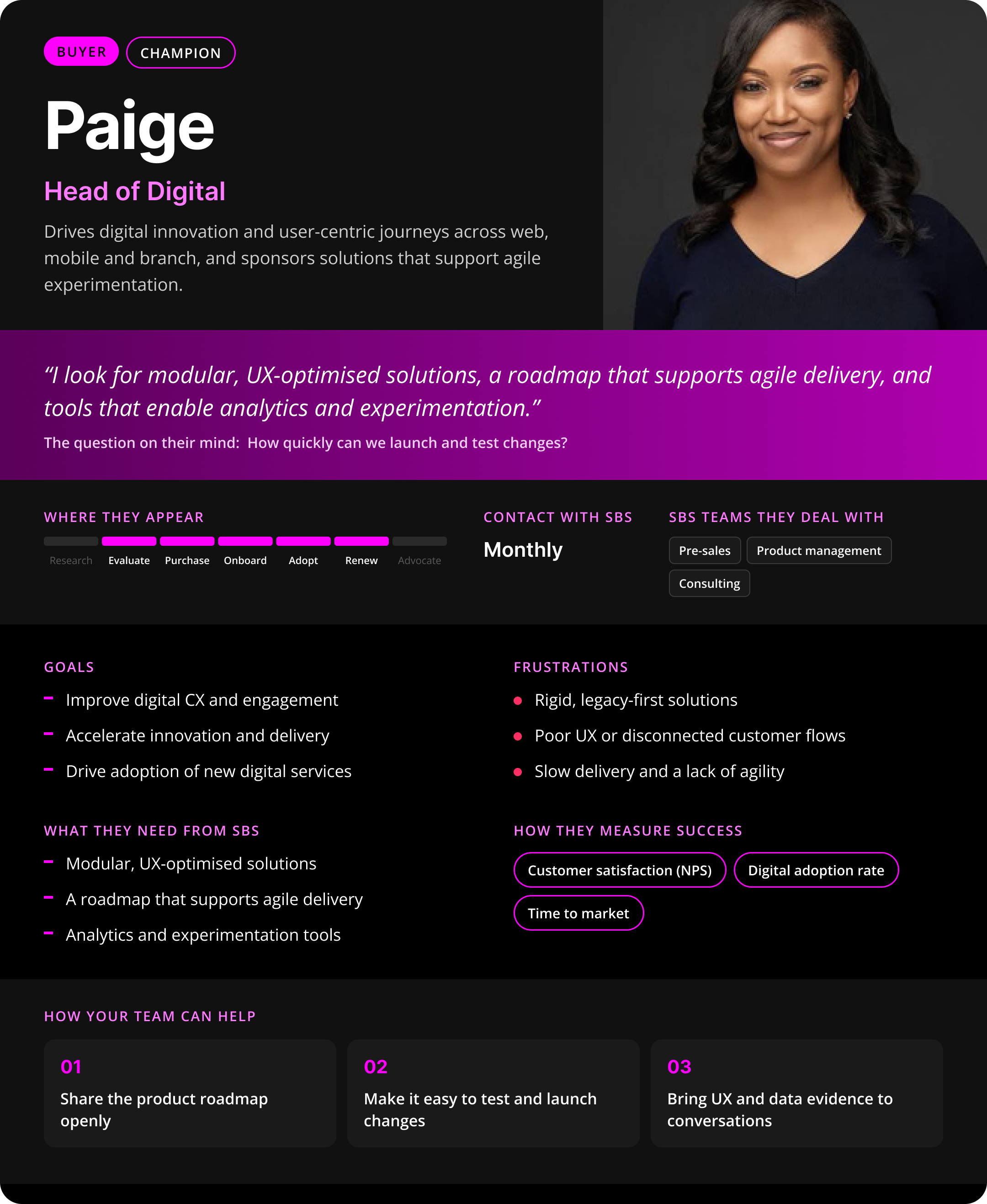
I created a set of user and buyer personas to accompany the journey map, as there isn’t really a point in knowing the customer’s journey if you don’t know who the customers are. This really helps with building empathy and bringing the customers into conversations. I created these personas based on customer feedback of the most common customer archetypes.
User personas
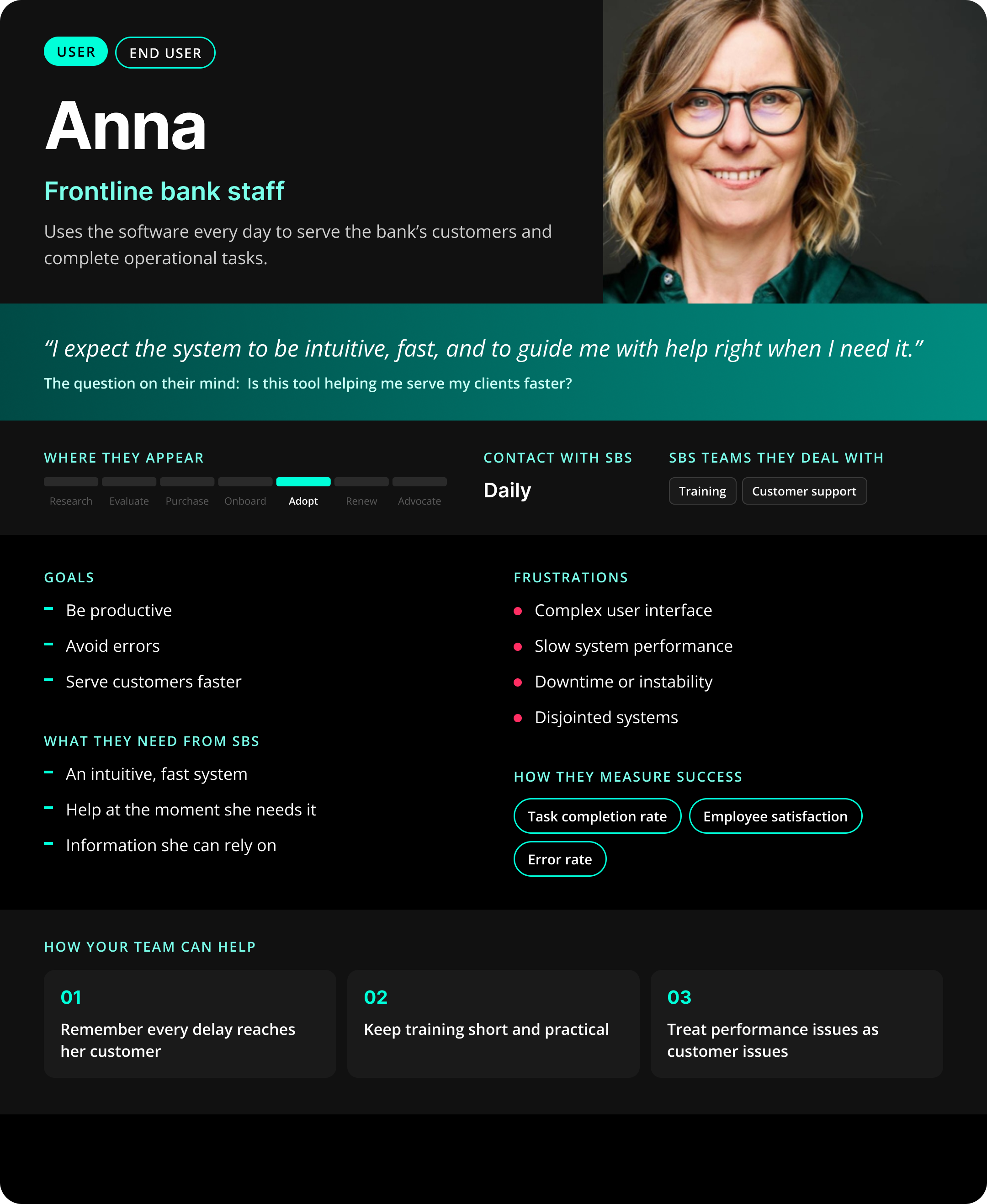
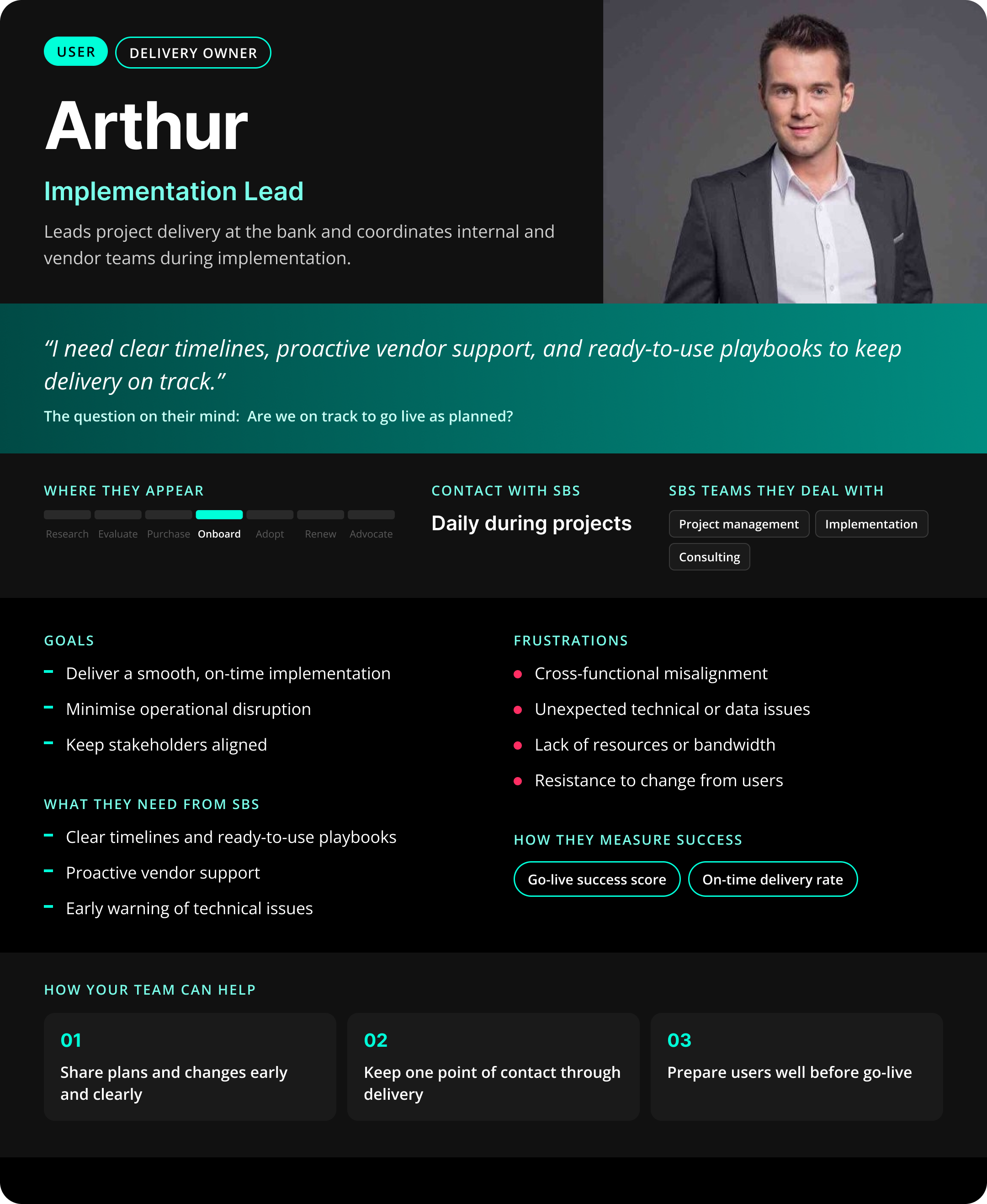
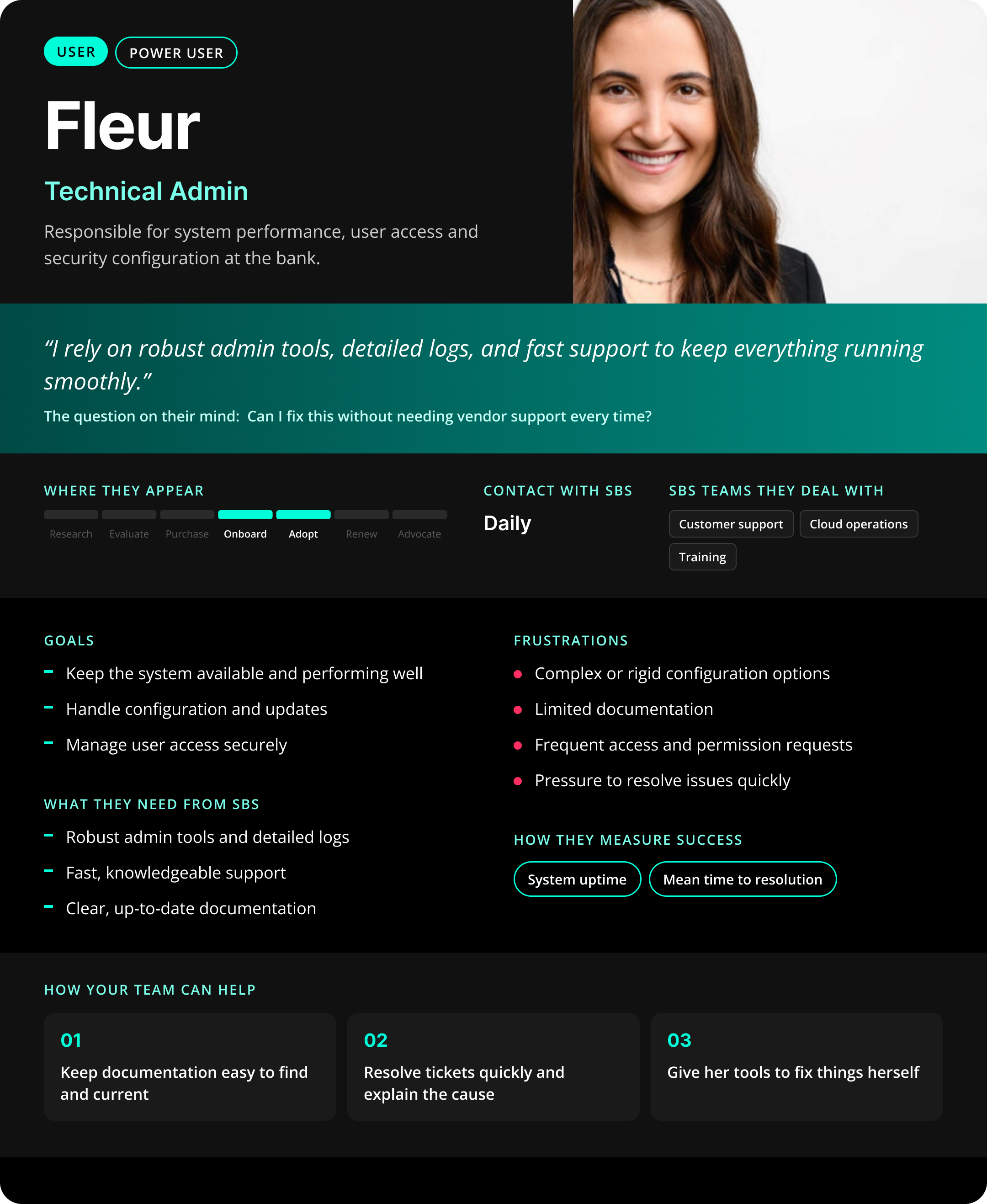
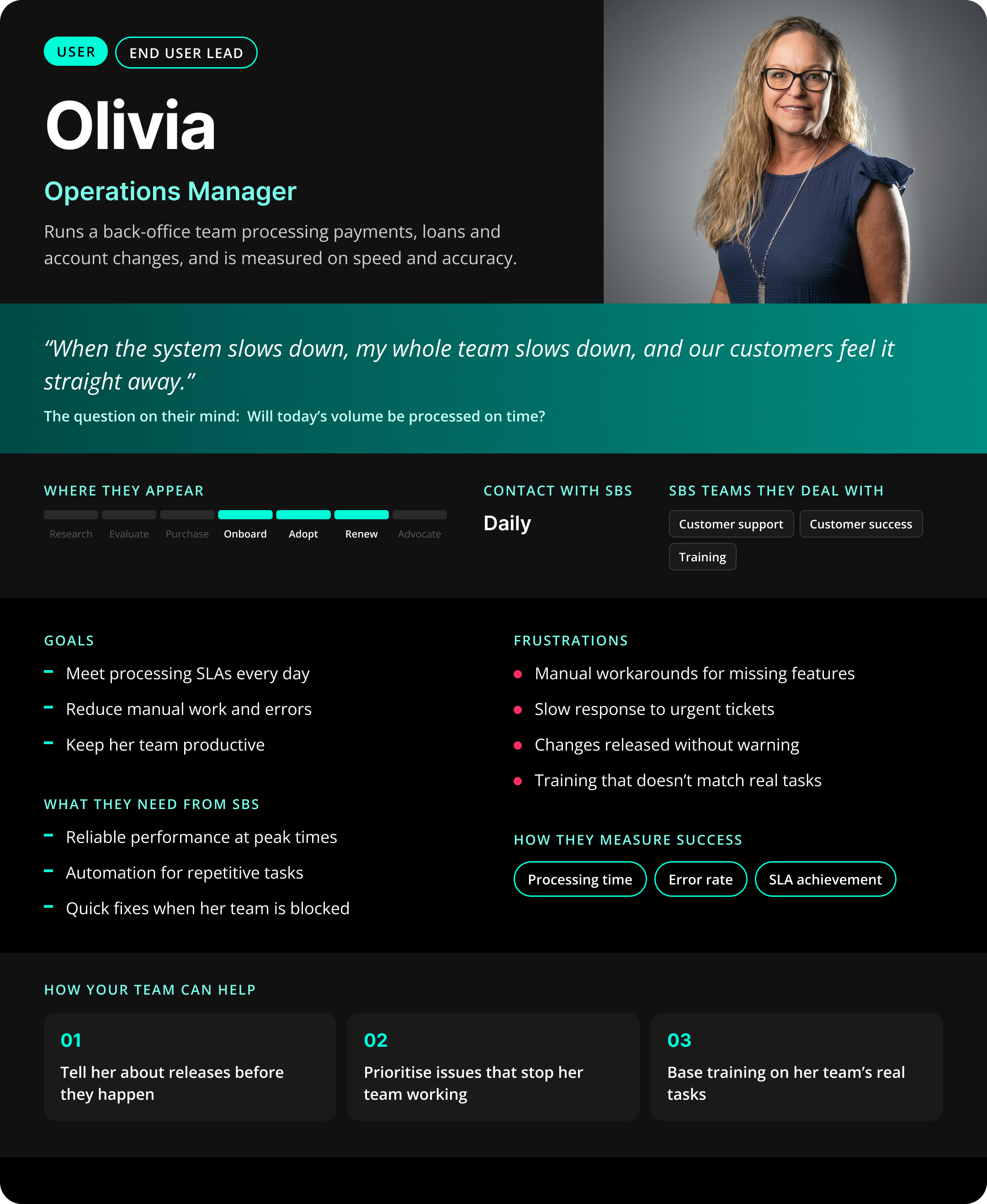
Buyer personas
Training module
I created a short video to explain the customer journey map and personas using Canva Pro, which was also recorded using my own voiceover. You can view the customer journey map video by following this link.
However, this e-learning had not been released yet, as this task was handed over to a colleague to reduce my workload.
Internal communication
To make sure the programme is visible for the foreseeable future, we needed a channel which didn’t stop communication about it. Viva Engage was the only channel we could use to keep customer centricity on people’s minds as the external communication team did not agree to communicate about it. I could have used email but as Viva Engage sent an email out for Announcement posts anyway, it was unnecessary.
I brainstormed content ideas which included monthly reports, event reports, voice of the customer videos, disciplines in the wild, praising employees, the list went on.
However, it became apparent very quickly that Viva Engage was not getting us the engagement we wanted. This was largely down to how saturated the channel was, so even if a post was viewed by 2000 people, this didn’t equate to who read it.
The graphic below shows a glimpse into how posts were performing:
I started off doing 3 to 4 posts a week but as I got analytics back which showed that engagement was low, I dropped posts to once a week. The posts that performed better were also ones that weren’t announced and had some sort of human touch to them. I always incorporated something which sparked discussion or related to a colleague in future posts. Monthly reports were definitely out the window as they didn’t create a sense of connection.
I would have liked to have delved deeper into what would have made Viva Engage work better for us, but time again was not on my side here as higher ups wanted to see results fast.
06
Creating the
internal
website
How to not let customer centricity be forgotten about
A key part of this programme is that it will stand the test of time, this means it wouldn’t just be forgotten about a couple of years after it’s launched. I needed to give customer centricity a permanent home at SBS, and a permanent home in the digital world is called a website by the way.
Ideally I wanted to carry out user research with future users to understand their needs from the website, however, I was impacted by time pressure so I gathered some informal feedback from colleagues and would iterate the website in the future once it launched.
Informal feedback from colleagues on the current Customer Satisfaction website
Before I made any changes to the old site, I asked colleagues from along the customer journey to visit the site and tell me what they thought of it.
This was the feedback I got.
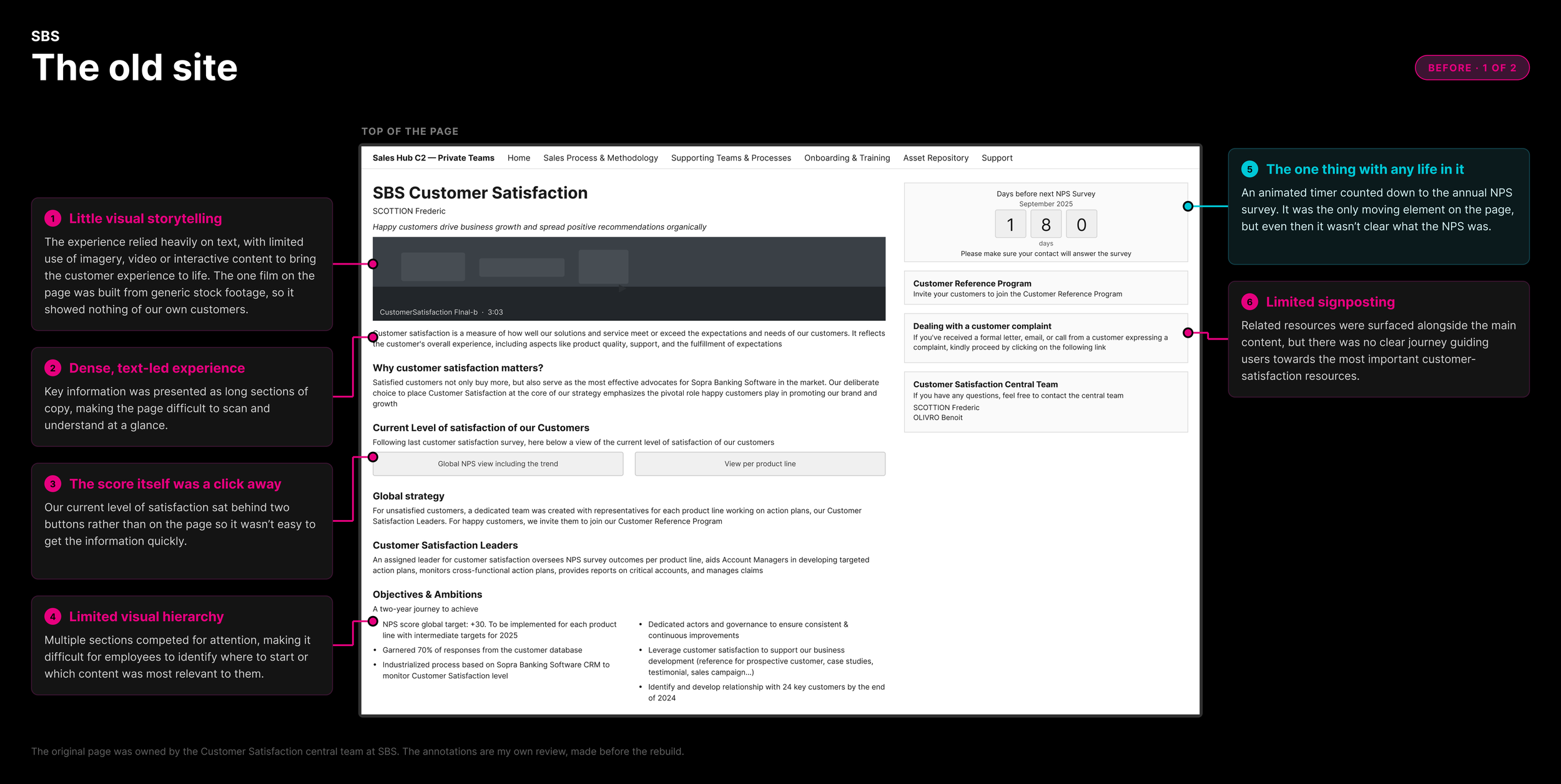
The old website
Before I started at SBS, a very simple website had been created which lacked any use of UX design and didn’t accommodate the needs of its users. The graphic below shows a mock up of the old website with annotations of where the website had its most major downfalls.
Asking for feedback before the launch
I rebuilt the website built on best UX practices, however, I wanted to get some more informal feedback so i quickly sent the draft site around to available colleagues. The only person who replied was Matt Elliott, but he gave some thorough feedback which I used in the final build before launch.
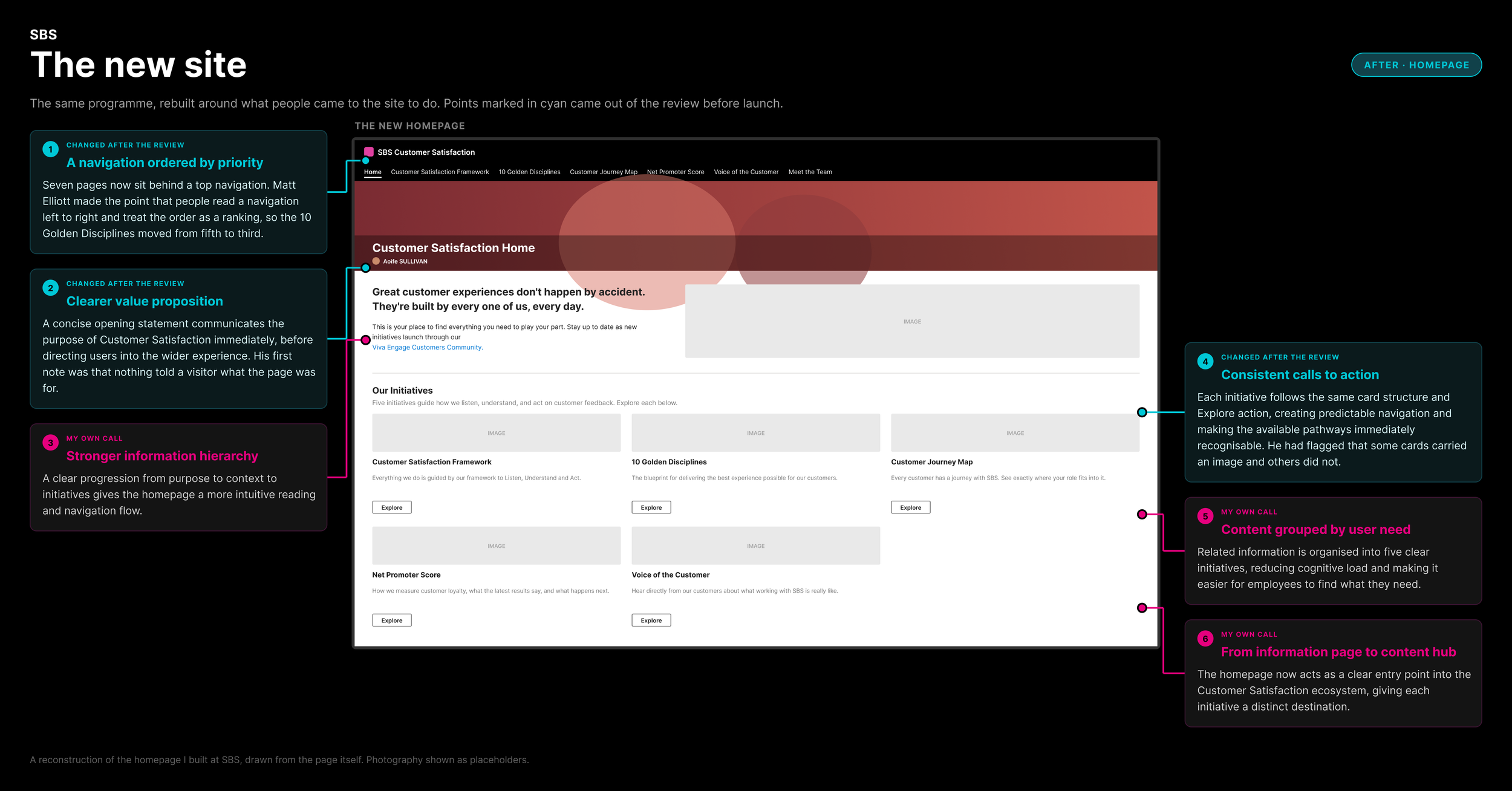
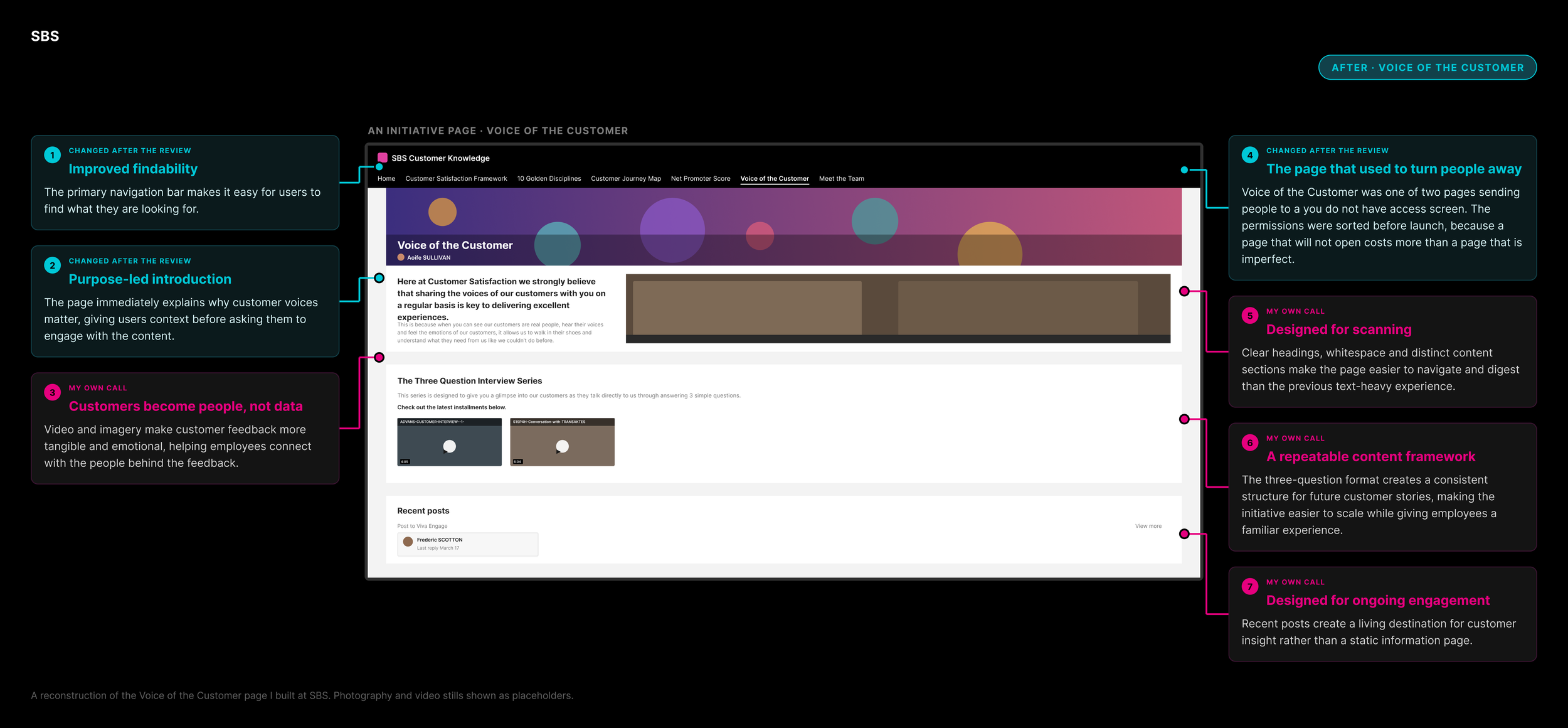
The new website
Unfortunately, after I left I was unable to access the site so I can’t link to the new website. However, I do have a mock up of the home page and 1 of the initiative pages. Every initiative follows this same structure to ensure consistency across pages to make for an easier to navigate experience.
Changing the copy
The website copy before made for a poor experience due to lack of direction, long winded explainations and not being written according to what the customer needed from the site.
07
The result
What changed after 16 months?
When I started at SBS, the customer satisfaction programme didn’t exist and now it’s a cornerstone of making sure we deliver an excellent customer experience from inside out.
Net Promotor Score
This was the main driver of the customer satisfaction programme on the surface, as from a business perspective this was what was being published on the market for the first time. We aimed for an NPS of +25, and we actually ended up exceeding this by 13.2 points! +38.2 was our 2025 NPS Annual Survey result, the highest score we’ve ever had.
Listening, understanding and acting
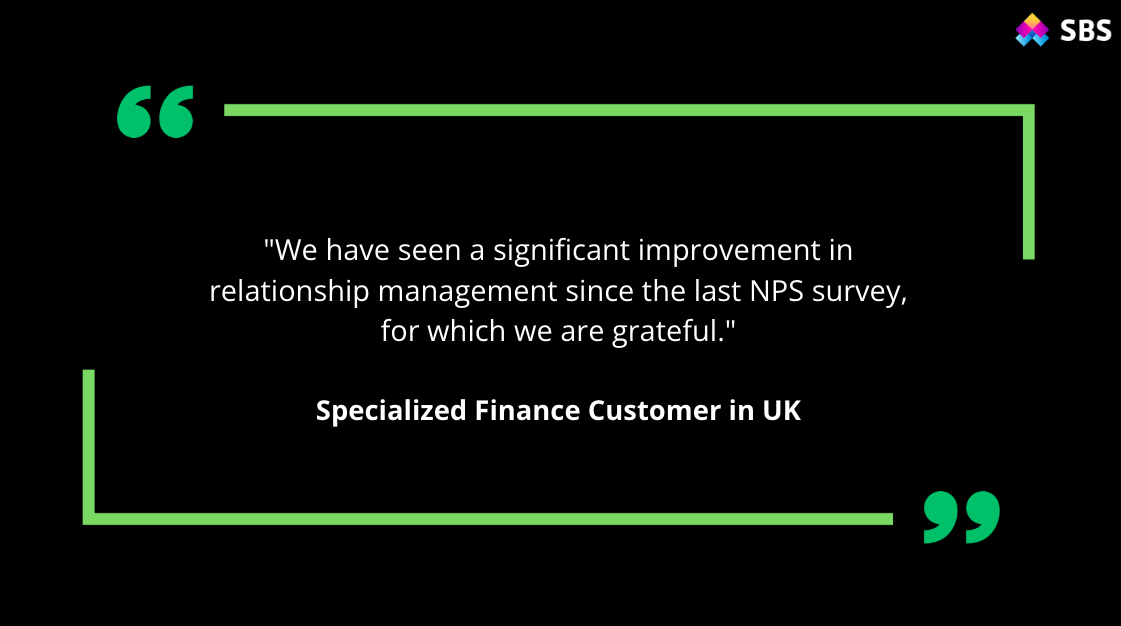
I created a framework which aimed to build empathy for the customer’s experience through education. Whilst I can’t conclude that this framework caused the NPS to rise, I received truly amazing feedback from the work I’ve done so far and people seem to be far more aware of our customers than they were before.
08
Reflection
What are my thoughts now looking back?
I’m proud of what I achieved
I really did everything I could with the means that I had available. It wasn't always easy to move things forward, but I'm proud of how much I was able to achieve, especially as I was building the customer satisfaction programme from scratch.
I wish I could have done more research
I learnt that you can't always follow a full UX process in an organisation where UX is still quite new, and that part of the role is helping people understand why it matters. I tried my best to do research to inform design where I could, but this wasn't always possible because of time, budget and other business priorities, so I learnt to make the most of the insight I was able to gather.
How you communicate is more important than anything else
I did know this already, but if you have something you want people to follow there’s a lot more to it than simply saying ‘follow this!’. You need to teach people why in a way that they understand and relate to. Publicly and in conversations with people.
I needed a bigger team
This was a big one for me, not only to spread the workload but also to have others to bounce ideas off. My manager and I didn't share a first language, which sometimes made it harder to talk ideas through in detail, but it encouraged me to share my thinking more visually through mockups and examples.
Designing for different languages and cultures
The programme had to work for people across different countries and languages, So, I learnt to keep content simple, clear and visual, and to avoid assuming that something which made sense to me would for everyone else too. It made me think much more carefully about inclusive and accessible communication.
Keeping one clear message across many channels
I was running the e-learning, Viva Engage content, workshops, SharePoint site and NPS work largely on my own so I had to make sure everything felt consistent and connected. It taught me to prioritise carefully and to think about how each piece fitted into the bigger picture rather than treating them as separate projects.
Working with stakeholders and approvals
Content often needed to go through approval processes and input from subject experts, so I learnt to plan ahead, allow time for feedback and bring people in early, which made the process smoother and helped build trust in the work.
Planning for handover
My contract ended while the e-learning and workshops were still being rolled out, so I didn't get to see the full impact of my work. It showed me how important it is to document decisions clearly and set things up so that others can carry them on, and in future I'd plan for that from the very beginning.
What I’ll take forward
This role showed me how much I enjoy taking an idea from nothing and turning it into something that people actually use and engage with.
I've learnt how to communicate clearly with a large and varied audience, how to make the most of whatever research and insight I'm able to gather, and how to use data to show the value of my work, even in an organisation where UX was still a fairly new way of working. I'm taking all of this into my next role, where I'd love to be part of a team that puts design and communication at the heart of the customer experience, and where I can keep growing as a designer alongside people I can share ideas with.